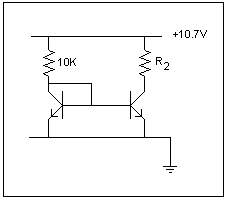
The circuit in Fig. 6.1
![[6.1]](/afs/glue.umd.edu/software/tetex/latex2html/latex2html-97.1/icons.gif/cross_ref_motif.gif) shows a current mirror, which is often used as constant-current-source. It
utilizes a pair of matched transistors Q1 and Q2
The fundamental idea behind the current mirror is that
base-emitter voltages VBE for both transistors are
equal.
shows a current mirror, which is often used as constant-current-source. It
utilizes a pair of matched transistors Q1 and Q2
The fundamental idea behind the current mirror is that
base-emitter voltages VBE for both transistors are
equal.
![[*]](/afs/glue.umd.edu/software/tetex/latex2html/latex2html-97.1/icons.gif/
foot_motif.gif)
Since Vbe1=Vbe2, then
according to equation (),
Ic1=Ic2, as long as both devices are in forward active mode.
We use this idea to establish a current source. We first set Ic1 to
a specific value. This then sets Ic2 to the same value, regardless
of the value of R2. Ic2 can thus be considered to be a current
source, since its value does not change no matter the value of R2.
(Provided of course that the BJT's do not saturate.)
To set Ic1, we take advantage of the short between the collector and base of Q1. We then obtain the following loop equation: